
MLTDM: Machine-learning thermospheric density model
Published:
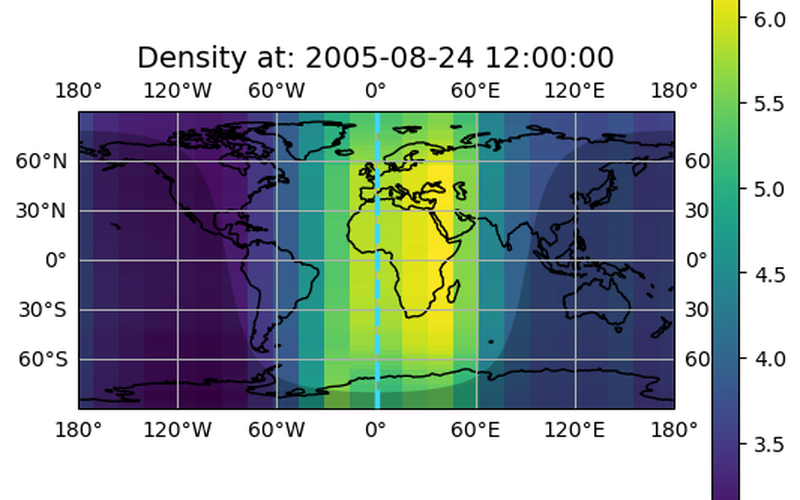
Satellite drag in low-Earth orbit is driven by thermospheric neutral density, and density can change dramatically during geomagnetic storms. Empirical models often miss these storm-time changes, which matters for conjunction assessment and orbit prediction for LEO constellations.
What I did
- Built a random-forest regression model of neutral density trained on CHAMP and GRACE accelerometer-derived density, using solar EUV irradiance (FISM2) and solar-wind/geomagnetic (OMNI) drivers as features. Storm-time density can rise by up to a factor of ~10 over quiet levels; models combining solar and geomagnetic drivers performed best during storms.
- Used the model to unpack why density changes during storms: permutation feature importance and storm-phase analysis separate the solar and geomagnetic contributions to the density response.
- Packaged the model so others can use it:
pip install, a config file, automatic download of the trained model and feature data, and an example notebook that produces global density maps like the one above.
Outcome: Peer-reviewed paper in Space Weather (Murphy et al., 2025), with the model archived on Zenodo.